Dark Legends
Arizona Red Ghost: The Camel That Haunted the Desert
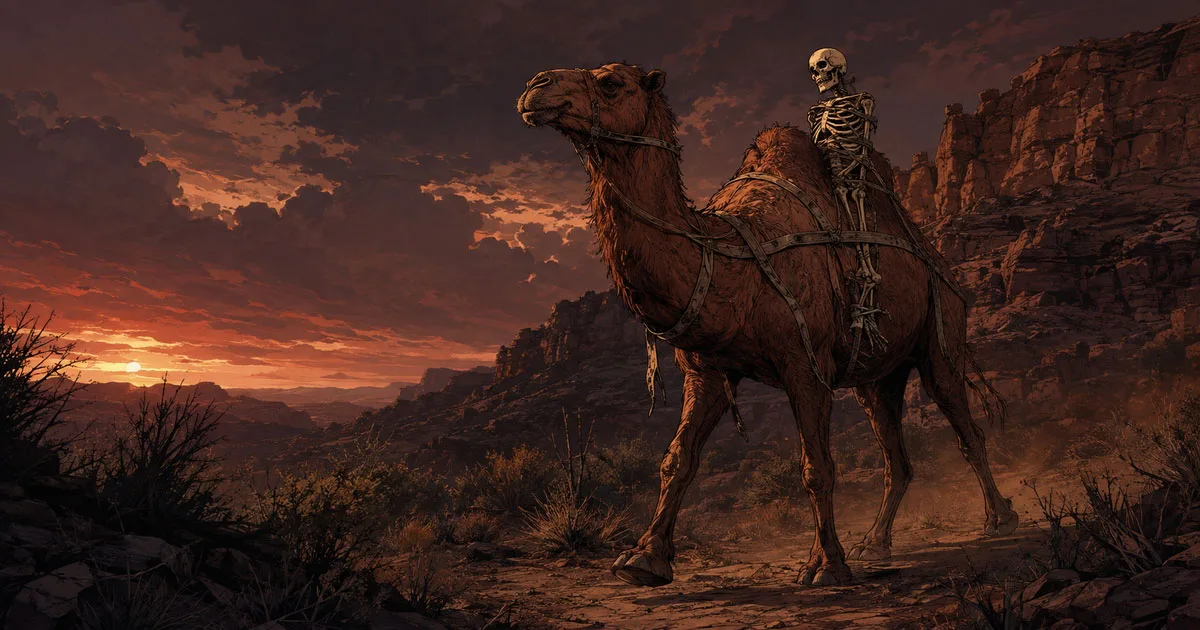
An illustrated interpretation of the Arizona Red Ghost legend and the skeletal burden reportedly fastened to the camel's back.
The thing coming through the Arizona brush was too tall to be a horse.
It was red beneath the desert dust. Its feet split the earth with broad, cloven tracks. Leather cut across its body, and something pale moved behind its hump. From a distance, that burden looked almost like a rider.
Almost.
In the spring of 1883, a story began moving through Arizona Territory. A woman near Eagle Creek had been found trampled beside a spring. A witness reportedly described an enormous reddish beast carrying a devilish figure. Prospectors later told of a creature that crushed their tent. Ranchers saw something towering over the chaparral. Then came the detail that transformed fear into nightmare: the rider appeared to be a dead man.
They called the creature the Arizona Red Ghost.
The legend sounds like frontier fantasy, yet a flesh-and-blood explanation waited beneath it. The monster was almost certainly a camel, one of the strangest survivors of a documented United States Army experiment. The corpse, the killing, and the camel's decade in the wilderness are harder to prove. Their surviving history lies where military records, territorial newspaper stories, and campfire embellishment meet.
The truth is not less frightening than the legend. It is lonelier.
Where the Arizona Red Ghost Story Began
The setting was Eagle Creek in eastern Arizona Territory, a rugged country of narrow watercourses, high desert vegetation, and broken stone. In 1883, isolation was not an atmosphere created for a story. It was an everyday condition. A ranch could be hours from help. A strange track in the mud could not be photographed and sent for identification. News moved from a frightened witness to a neighbor, then to a mining camp, and finally into a newspaper.
The Arizona Red Ghost entered that world during a period already marked by violence and anxiety. Some later retellings place the first encounter near the time of an Apache raid associated with Geronimo. That context appears in twentieth-century accounts, but it should be handled carefully. The legend concerns a camel and a mysterious death, not an excuse to turn Apache people into scenery for someone else's monster story.
The surviving versions also disagree about the sequence of the earliest sightings. A 1935 Arizona Highways article, drawing on an 1893 territorial newspaper story, placed an encounter with prospectors before the Eagle Creek death. A 1961 American Heritage article began with the woman at the spring. Both versions agree on the elements that became the legend's foundation: a huge reddish animal, strange tracks, red hair caught on brush, and witnesses who could not immediately name what they had seen.
Memory had already begun rearranging the darkness.
The Woman at Eagle Creek
In the best-known account, two women and several children remained at an adobe ranch house while the men were away. One woman went to collect water from a nearby spring. The dog began barking. A scream followed.
The woman inside looked out and caught a brief glimpse of something enormous and red moving near the spring. A figure seemed to ride upon its back. Terrified, she secured the house and waited for the men to return.
They reportedly found the other woman dead near the water. Later accounts say her body had been badly trampled. Around her were oversized cloven tracks and reddish hair clinging to the willows.
The woman's name is not preserved in the commonly cited retellings. Neither is a readily accessible inquest record that would allow us to verify the precise cause and circumstances of her death. American Heritage stated that the coroner permitted a verdict of death “in some manner unknown,” but the article appeared in 1961, nearly eight decades after the event it described.
That does not make the story false. It makes it incomplete.
The Arizona Red Ghost may have killed a woman by trampling her. She may have died after being startled, struck, or caught in the path of a panicked animal. Some details may have been enlarged as the tale traveled. What survives with certainty is the story Arizona remembered: a woman went to the spring, a terrible shape appeared, and only one of them returned.
A Monster Moves Across Arizona
Soon, new sightings gave the terror distance and momentum.
Prospectors working near a tributary of the San Francisco River said their tent collapsed over them during the night. They heard pounding feet and a shriek, then saw a towering animal tear through the brush. Men who examined the area reportedly found enormous tracks, broken vegetation, and more red hair.
The mining camps did what isolated communities have always done with fear. They told the story again.
Each telling gave the Arizona Red Ghost another impossible ability. It vanished while being chased. It stood thirty feet high. It overturned wagons. One version even had it attacking a grizzly bear. These additions are frontier folklore, not reliable zoology. Yet their exaggeration may preserve the emotional truth of encountering a camel without expecting one.
A dromedary can stand roughly six feet at the shoulder and considerably higher at the head. Its long legs, swaying gait, elongated neck, and unfamiliar cry can be deeply unsettling. Seen at night by someone who knew horses, cattle, deer, and bears but had never seen a camel, it could appear built from the wrong pieces.
Horses were frightened by camels too. The Army discovered that unfamiliar horses and mules could panic at their smell and appearance. That reaction could turn an ordinary sighting into a stampede, an injury, or a tale of a creature that carried terror with it.
The Dead Rider
Rancher Cyrus Hamblin reportedly supplied the identification that pulled the monster into the natural world. From across a ravine, he saw the reddish animal moving through the brush and recognized it as a camel.
Then he noticed its burden.
Something shaped like a man sat behind the hump, but it did not move like a living rider. According to the story, five prospectors later fired at the camel. The animal escaped, but an object fell from its back. The men found a human skull with traces of tissue and hair still attached.
This is the image that made the Arizona Red Ghost unforgettable: a living camel wandering beneath a dead master, carrying him long after command, direction, and purpose had vanished.
The skeletal rider is widely repeated, but no identified remains, burial record, or surviving physical specimen establishes who the person was. Even Robert Froman's detailed 1961 account acknowledged that the territorial press was not always ruled by strict fact. The story may preserve a genuine discovery, a partially seen pack mistaken for remains, or a macabre invention that became attached to a real feral camel.
Still, one later detail makes the burden disturbingly plausible. When the camel was reportedly killed, old rawhide strips were said to cover its body in a tight network, leaving deep scars. Something had once been fastened there.
Why Were Camels Wandering in Arizona?
The answer begins with a practical military problem.
During the nineteenth century, the United States expanded into immense arid regions where horses and mules required frequent water and large quantities of feed. Army officers wondered whether camels, adapted to harsh deserts, might carry supplies more efficiently.
The proposal was real. In 1855, Secretary of War Jefferson Davis persuaded Congress to appropriate $30,000 to acquire camels and test them for military transportation. Major Henry C. Wayne and naval officer David D. Porter traveled to the Mediterranean to purchase animals and hire handlers. The first shipment reached Indianola, Texas, in 1856.
The animals were not a ceremonial curiosity. They were loaded, marched, measured, and tested.
This documented experiment provides the strongest historical foundation for the Arizona Red Ghost. A camel in territorial Arizona was strange, but it was not impossible. Government camels had crossed the region, private owners later purchased some, and loose or abandoned animals continued to appear in the Southwest.
The U.S. Army Camel Corps Experiment
In 1857, Edward Fitzgerald Beale led a survey for a wagon road from Fort Defiance toward the Colorado River. His expedition included twenty-five camels. Their route crossed Arizona's high desert, passed through brutally dry country, and tested the animals on stone, sand, cold, heat, and limited water.
The camels performed remarkably well.
Beale's journals, quoted by the U.S. Army, record his growing admiration. The animals carried heavy loads, kept pace with the wagons, and crossed punishing terrain without stumbling. During a water crisis near present-day Winslow, the mules became frantic while the camels continued browsing.
The popular phrase “U.S. Camel Corps” can create the wrong image. This was not a regiment of soldiers charging into battle on camelback. It was an Army transportation experiment centered on pack animals. Even so, the camels proved they could work in the Southwest.
Their success makes the outcome more tragic. The experiment did not end because the animals were incapable. It collapsed because institutions, people, and history moved against them.
How a Successful Test Became a Failure
Camels had disadvantages that statistics could not erase. Their odor and unfamiliar appearance upset horses and mules. Many soldiers disliked handling them. Saddles, training, and experienced drovers were not widely available. Officers who supported the program moved on, and Congress declined requests to expand it.
Then the Civil War divided the country.
By 1861, the federal camel herds were split between Camp Verde, Texas, and Fort Tejon, California. Confederate forces captured the Texas animals. The California herd saw only limited use. In February 1864, thirty-seven camels at Fort Tejon were sold at auction in San Diego. Other government camels were disposed of after the war.
Some went to circuses, ranchers, freight operators, and prospectors. Some escaped. Later folklore says others were simply released, although the documented disposal history is more complicated than one dramatic moment when the Army opened a gate and abandoned them all.
By 1883, the year the Arizona Red Ghost supposedly appeared at Eagle Creek, an Army camel could have survived into old age, but its direct identity would be difficult to prove. The animal might instead have descended from imported stock or escaped from a private owner. Linking this specific camel to Beale, Hi Jolly, or one particular Army herd is reasonable speculation, not established fact.
The Arizona Red Ghost Meets a Cowboy
As the legend continued, a cowboy at the Anchor-JOT ranch east of Phoenix found an unfamiliar animal inside a corral. When it charged, he reacted from habit and threw his lariat.
The rope caught.
His horse had no training for what came next. The camel turned toward them, the horse panicked, and animal and rider went down. The camel escaped, dragging a long length of rawhide rope.
The cowboy reportedly saw enough at close range to confirm two things. The animal was a camel, and a human body had been fastened to its back. By then, much of the burden had broken away.
After this encounter, the creature's supernatural career began to fade. Without the recognizable shape of a dead rider, it was easier to see a feral camel instead of a desert demon. Sightings continued, but fear slowly became folklore.
The Reported Death of the Red Ghost
On February 25, 1893, the Mohave County Miner reportedly announced that the phantom had been killed. The story was later reprinted or quoted by Arizona Highways.
Mizoo Hastings, a rancher near the mining camp of Ore on the San Francisco River, looked outside one morning and saw a large red camel eating in his turnip patch. He rested his rifle on the window and fired.
The Arizona Red Ghost died as an animal, not an apparition.
The account says its hide was marked by a network of knotted rawhide. Some straps had remained so long that they cut into the camel's flesh. Hastings reportedly intended to tan the hide and turn it into cowboy boots.
No preserved hide, skeleton, museum specimen, or photograph has emerged to settle the case. The animal's death survives through the newspaper tradition. If the report was accurate, it confirms a scarred feral camel but does not independently prove every earlier attack or the identity of the burden it once carried.
There is a quiet cruelty in the ending. For years, people described the camel as malicious. Yet an animal bound in old leather, injured by its load, shot at, chased, and feared might have been reacting to pain and terror of its own.
Perhaps the ghost was never the rider.
Perhaps it was what people made of the animal beneath him.
What Was Tied to the Camel?
Several explanations have been offered, and none can be proven.
One theory says a traveler dying of thirst tied himself to the camel, hoping it would carry him to water. Another says the man was a soldier or inexperienced rider secured to the saddle before the camel bolted. A darker interpretation claims someone deliberately fastened a corpse to the animal as punishment, cruelty, or a grotesque joke.
Each theory tries to close a gap the evidence leaves open.
If the skull story and rawhide scars are accurate, then someone had been bound to the camel with unusual force. We do not know whether that person was alive or dead, willing or helpless. We do not know his name. We do not know who tied the knots.
The Arizona Red Ghost carries that unanswered question through every version of the tale. The camel was eventually identified. The rider never was.
What Is Documented and What Is Folklore?
The United States Army camel experiment is documented through government records, military history, Beale's reports, and institutional scholarship. Camels crossed Arizona. They performed transportation work. The herds were later sold, scattered, or transferred into private hands.
A large red camel wandering Arizona in the late nineteenth century is historically plausible.
The 1893 territorial newspaper account of Mizoo Hastings killing a scarred camel is a contemporary report as preserved by later publications. It is valuable evidence, but it does not equal a surviving carcass, official veterinary record, or photograph.
The Eagle Creek death, giant hoofprints, fallen tent, skull, lassoing, and attacks survive mainly through newspaper storytelling and later histories. Some may rest on real events. Exact dates, locations, sequence, witness identities, and dramatic details vary.
The thirty-foot monster, disappearing creature, and grizzly fight are clear embellishments.
That leaves the Arizona Red Ghost neither debunked nor verified in every detail. It leaves us with a real military experiment, a plausible feral camel, a reported death, unexplained rawhide scars, and a skeletal rider who may have existed but cannot now be identified.
Why the Arizona Red Ghost Still Haunts Us
Many monsters become less frightening when they are explained. This one becomes sadder.
The Arizona Red Ghost was not a demon born from the desert. It was probably an imported animal left behind by human ambition. People brought camels across an ocean, tested them, sold them, lost them, and later treated their feral descendants as targets. Someone may have strapped a man to one so tightly that the leather cut into its body.
Then the wounded creature entered human memory as a murderer.
Perhaps it did trample the woman at Eagle Creek. Perhaps its fear met hers beside the spring, and neither understood the other until it was too late. Perhaps some of the tale was built from unrelated encounters and an editor's appetite for the uncanny.
We cannot restore the woman's name from the familiar accounts. We cannot name the dead rider. We cannot examine the camel's scars.
We can only watch the shape they left behind: a red animal moving across the Arizona dusk, a silent figure bound to its back, and a human story tied so tightly around both that more than a century has not pulled the knots apart.
Sources and Credibility
- U.S. Army University Press: The United States Army Camel Corps, 1856–66 | Credibility: 10/10. An official Army historical study using government reports, military correspondence, Beale's journal, and period records.
- Army Historical Foundation: The U.S. Army's Camel Corps Experiment | Credibility: 9/10. A military-history institution's sourced overview of the appropriation, acquisition, personnel, and operation of the camel experiment.
- Arizona Highways: Beale's Trail and the Red Ghost | Credibility: 8/10. A respected Arizona historical publication that quotes the February 25, 1893, Mohave County Miner report, though its narrative also preserves folklore.
- Arizona Highways: Arizona's Phantom Terror | Credibility: 7/10. A 1935 retelling close enough to the territorial era to preserve early tradition, but still written as a dramatic popular-history story.
- American Heritage: The Red Ghost | Credibility: 7/10. A detailed 1961 synthesis that distinguishes obvious tall tales from the central account, but was published decades later and relies heavily on territorial newspaper reporting.
Historical note: This article treats the Army camel experiment as documented history, the scarred feral camel as a credible period report, and the killing and skeletal rider as unresolved claims preserved through Arizona folklore.