Dark Legends
Greenbrier Ghost: The Life, Death, and Strange Justice of Zona Heaster Shue
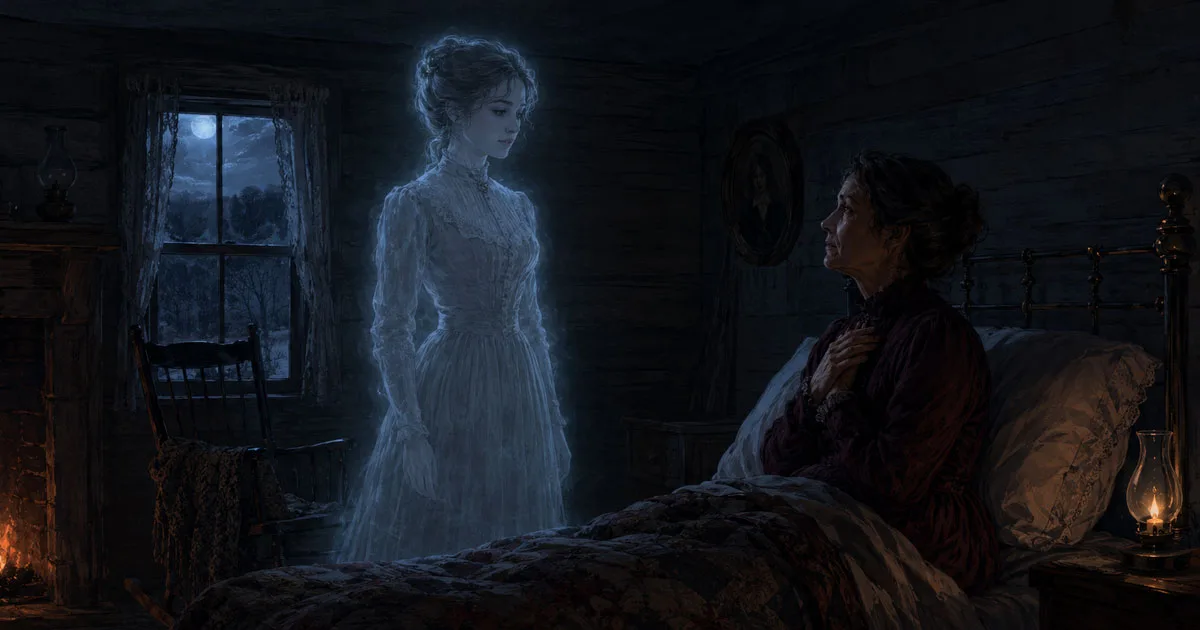
An illustrated interpretation of Mary Jane Heaster's claimed encounters with the Greenbrier Ghost.
Before Greenbrier County called her the Greenbrier Ghost, she was Elva Zona Heaster.
To her mother, Mary Jane, she was simply Zona.
That distinction matters. The legend is usually introduced with a dead woman, a midnight visitation, and a neck turned at an impossible angle. Yet Zona had lived an entire life before folklore reduced her to an apparition. She was a farmer's daughter, a sister, a young mother, and a woman who appears to have entered a dangerously hurried marriage hoping for a new beginning.
In January 1897, that future ended inside a small house near Livesay's Mill, West Virginia. A local doctor initially failed to discover what had happened. Zona's husband covered her neck and guarded her body. Her burial might have closed the case forever if Mary Jane Heaster had accepted the official explanation.
She did not.
Mary Jane said her daughter returned over four nights and described her murder. Whether those visits were supernatural, psychological, or a determined mother's way of giving form to suspicions she could not ignore, the Greenbrier Ghost story did something extraordinary. It pushed the living to look again.
Who Was Zona Heaster Shue?
The surviving records leave Zona's earliest years in shadow. The 1880 census appears to list her as a seven-year-old living with her parents, Jacob and Mary Jane Heaster, and an older brother. That suggests a birth around 1873, although her gravestone gives 1876. Even the year of her birth became uncertain while the circumstances of her death grew famous.
Zona grew up among the farms and wooded hills of Greenbrier County. Her father worked the land. Her mother's labor was the relentless work that kept a rural household alive: meals, washing, mending, water, gardens, and food preserved for winter.
The family endured loss. Zona's younger sister Lennie died in 1891 at about three years old. Four years later, on November 29, 1895, county records listed Zona as the unmarried mother of a son and identified George Wooldridge as the father. What happened to the child remains uncertain. Family accounts and later genealogical claims conflict, and no strong surviving record settles his fate.
We should resist filling that silence with romance or scandal. We do not know whether Zona loved Wooldridge, whether marriage had been promised, or whether she raised the child herself. We can say only that an unmarried pregnancy in a small nineteenth-century community likely exposed a young woman to judgment that did not fall equally upon the man.
This was the woman who met a traveling blacksmith in the autumn of 1896. Her story did not begin with the Greenbrier Ghost. It began with a young person carrying grief, uncertainty, and the hope that life might still open into something better.
The Greenbrier Ghost Story Begins With a Hurried Marriage
The blacksmith called himself Edward or Trout Shue. His fuller name appears in different forms, including Erasmus Stribbling Shue. He was older than Zona, practiced a dependable trade, and was reportedly handsome. A skilled blacksmith could find work wherever farms, horses, wagons, and tools required iron.
Edward may have looked like security. He may have seemed to offer Zona a home, respectability, or simple affection. No letter tells us what he promised. Their courtship lasted only weeks, and they married in October 1896 despite Mary Jane's opposition.
Edward's past made that speed more troubling. He had served time for horse theft and had been married twice. His first marriage ended in divorce amid allegations of cruelty. His second wife died, although sensational later stories about Edward's responsibility are inconsistent and should not be repeated as proven fact.
We also do not know how much Zona knew.
Abusive control rarely announces itself honestly. Possessiveness can first appear as devotion. Demands may be framed as concern. Then questions become accusations, ordinary mistakes become offenses, and the victim learns to measure every word against another person's anger.
Mary Jane later maintained that Edward mistreated Zona. The surviving record does not preserve a diary, a letter, or an eyewitness account of specific assaults during the short marriage. That absence is not proof of peace. It means the private life of a vulnerable woman was poorly recorded until violence made it public.
Zona and Edward had been married for roughly three months when January 23, 1897, arrived.
The Morning Zona Was Found
That Saturday morning, Edward visited the nearby home of Martha Jones, known locally as Aunt Martha. He wanted her young son, Anderson, to go to the Shue house. Edward said Zona might need help with chores or have eggs she wanted carried to the store. Accounts state that he returned more than once to ask whether the boy had gone.
At about eleven o'clock, Anderson entered the silent house and found Zona lying near the foot of the stairs. Her eyes were open. One arm was beside her, while the other extended across the floor.
The boy ran for help.
By the time Dr. George Knapp arrived, Edward had moved Zona upstairs. He had washed her, helped dress her in a high-necked garment, and placed a large folded veil or scarf around her throat. He held her head, rocked her, and wept.
Grief can look strange, and a husband holding his dead wife is not evidence of murder by itself. Yet Edward's actions also controlled the scene before the doctor could examine it. The official Greenbrier County account preserves testimony that the husband asked Knapp not to continue the examination and that witnesses noticed how loosely Zona's head moved when unsupported. The regional history published by Greenbrier County likewise describes the high collar, folded veil, and unusually loose neck in testimony reported by the Greenbrier Independent.
The Greenbrier Ghost legend would later center on Mary Jane's visions, but the first warning signs were physical and immediate.
The Hidden Neck and Incomplete Examination
Dr. Knapp performed only a limited examination. Later descriptions vary about the natural cause he initially considered. Versions mention heart trouble, an “everlasting faint,” childbirth, or complications associated with pregnancy. No clear surviving evidence establishes that Zona had recently given birth to another child.
What matters is what the first examination did not include. Knapp did not properly inspect the neck hidden beneath Edward's careful arrangement.
Zona was buried at what is now known as Soule Chapel Methodist Cemetery. Mary Jane had already buried one daughter. Now she stood beside the grave of another, a young woman whose death had been accepted without a complete medical examination.
The collar bothered her. The veil bothered her. Edward's insistence on supporting Zona's head bothered her. So did the speed with which a healthy young woman's death had been explained and closed.
Mary Jane began to pray, not merely for comfort, but for an answer.
Four Nights With the Greenbrier Ghost
According to testimony Mary Jane later gave under oath, Zona came to her over four nights. Mary Jane insisted that she was awake and that her daughter appeared in the flesh, wearing the dress associated with her final hours.
The Greenbrier Ghost reportedly described mistreatment inside the marriage and a final quarrel over supper. Edward was angry because he believed Zona had failed to prepare meat. Zona listed the food that had been available, as though she were still defending herself: butter, apple butter, fruit, preserves, and jelly.
Then she described the attack.
Mary Jane said Zona told her that Edward seized her by the head and neck, strangled her, and twisted until the bones at the top of the spine separated. As the apparition departed, Zona turned her head around to demonstrate what had been done.
The scene is the chilling heart of the Greenbrier Ghost story. It is also a claim made by Mary Jane, not an independently witnessed supernatural event.
There are several ways to understand it. Grief may have produced vivid dreams or waking experiences. Mary Jane's mind may have assembled the hidden neck, loose head, rushed preparation, and Edward's known behavior into a truth she already suspected. She may have invented the visits because a ghostly accusation could make suspicious neighbors and reluctant officials listen. Or Zona may truly have found a way back to her mother's room.
The historical record cannot choose among those possibilities.
What it does show is that Mary Jane acted.
The Exhumation and Earthly Evidence
Mary Jane went to Greenbrier County prosecutor John Alfred Preston and accused Edward of murder. She told him about the visits, but a ghost story alone could not establish a homicide.
Preston questioned the living. He learned that Knapp's examination had been incomplete. He considered Edward's interference, his handling of the body, the concealed neck, and the observations of witnesses. These were earthly reasons to reopen the case.
On February 22, 1897, Zona's body was exhumed and examined in a nearby schoolhouse. The doctors found a crushed windpipe, marks of pressure around the throat, torn ligaments, and a neck dislocated between the first and second vertebrae. The medical findings showed that Zona had been strangled and her neck broken.
The injuries closely resembled what Mary Jane said the Greenbrier Ghost had described.
Edward Shue was arrested that day.
This distinction protects the truth at the center of the story. The apparition did not perform the autopsy. It did not create the injuries. Mary Jane's persistence caused authorities to conduct the examination that should have happened before burial, and the body supplied the evidence.
Did Ghost Testimony Convict Edward Shue?
Edward's murder trial began in June 1897. The prosecution focused on physical evidence and human conduct. It did not need to prove that a spirit had crossed the boundary between death and life.
Mary Jane testified. The prosecutor reportedly avoided making the apparitions the center of his case. The defense chose to question her about them, apparently hoping the story would make her seem irrational.
She did not retreat.
Mary Jane insisted that the encounters were no dream and affirmed that Zona had returned four times. By raising the matter, the defense placed the Greenbrier Ghost before the jury. That does not mean a ghost legally testified or that supernatural evidence alone convicted Edward.
The jury also heard about the condition of Zona's body, Edward's behavior after her discovery, and his effort to prevent a complete examination. After a short deliberation, Edward was convicted of first-degree murder and sentenced to life in the West Virginia State Penitentiary. He died there in 1900.
The popular claim that this was the only American murder conviction won through ghost testimony is an irresistible headline, but it oversimplifies the case. A more accurate statement is stranger in its own way: a mother's account of a ghost helped drive renewed scrutiny, while physical evidence and circumstantial facts supported the conviction.
What Is Fact, Folklore, and Interpretation?
The Greenbrier Ghost story survives where law, family memory, newspaper reporting, and folklore overlap.
Documented facts include Zona's marriage, her death in January 1897, the incomplete initial examination, the concealment of her neck, the exhumation, the fatal neck injuries, Edward's arrest, Mary Jane's courtroom testimony, and Edward's conviction.
Mary Jane's four encounters are documented as her sworn claim. Their supernatural nature is not verifiable. That difference does not require us to ridicule her. People report vivid experiences in grief, and the historical importance of her testimony rests partly in what she did because of it.
Later reports of cold spots, perfume, whispers, and a woman near Zona's grave belong to modern folklore. No strong historical record shows that Zona continued appearing after the four visits her mother described.
Perhaps she did not need to.
Why Zona's Story Still Matters
The most enduring part of the Greenbrier Ghost is not the rotating head or the courtroom novelty. It is the refusal to let a woman disappear beneath someone else's explanation.
Zona could no longer answer questions. Edward controlled her body before the doctor arrived and covered the place where the evidence lay. An incomplete examination turned violence into a mysterious natural death. Mary Jane interrupted that process.
Because she persisted, the grave was opened. Because the grave was opened, the injuries were discovered. Because those injuries were documented, the man who concealed them faced a jury.
Was Zona standing beside her mother's bed? Was Mary Jane translating suspicion into the language her community would hear? Can grief expose patterns that shock once allowed everyone else to overlook?
The Greenbrier Ghost leaves those questions in the dark. Yet it illuminates one truth clearly. Before she was a legend, Zona was a daughter, and her mother refused to let silence become the final word.
Sources and Credibility
- West Virginia Encyclopedia: Greenbrier Ghost | Credibility: 9/10. Published by the West Virginia Humanities Council and grounded in regional historical scholarship.
- Greenbrier County Convention and Visitors Bureau: The Greenbrier Ghost | Credibility: 8/10. A carefully researched local history drawing on contemporary newspaper reporting, although written for a general audience.
- Greenbrier County trial-record summary via e-WV | Credibility: 9/10. Useful for confirming the existence of the courthouse record and Mary Jane's reported testimony.
Historical note: This article distinguishes documented events from disputed details and supernatural interpretation. No post-1897 haunting claim is presented as verified fact.