True Encounters
The Ghost Raft of Guadalcanal
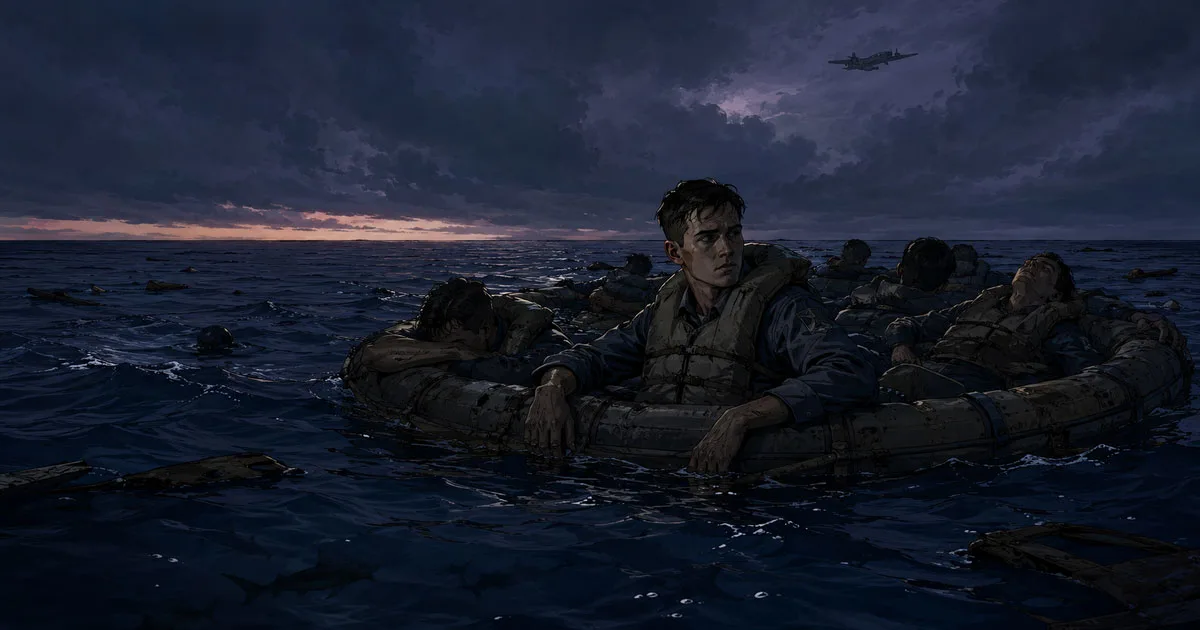
An illustrated interpretation of Allen Heyn and other USS Juneau survivors awaiting rescue in November 1942.
Watch the story
The ocean did not become silent when the USS Juneau disappeared.
At first there were men shouting through oil and wreckage. Some called for friends. Others cried from injuries suffered in the explosion. A passing aircraft banked low enough for the survivors to see its crew wave, and hope moved across the water almost as quickly as the news that they had been seen.
Then no rescue came.
The wounded died. The thirsty became delirious. Sharks moved beneath the scattered floats. Lines joining the rafts parted in rough water, and small groups drifted away from one another. By the time Allen Clifton Heyn was found, he was alone on a float that had once held many men.
That is why the story can feel like a ghost tale even though no reliable record describes a supernatural encounter. The raft became a place occupied by absence. Every empty space marked someone who had been alive the day before.
This is the documented horror of the USS Juneau, told through the recollections of one sailor who remained when almost everyone around him was gone.
What Was the USS Juneau?
The USS Juneau was an Atlanta-class light cruiser commissioned in February 1942. Built as a fast anti-aircraft cruiser, she carried batteries intended to protect fleet formations from enemy aircraft, but the brutal naval campaign around Guadalcanal demanded far more than her original design promised.
By November, American and Japanese forces were locked in a struggle for the Solomon Islands. Guadalcanal mattered because control of its airfield and surrounding waters could influence communications and operations across the South Pacific. Ships entered the narrow waters around the island at night, often fighting at such close range that identification, formation, and command broke down.
The sea between Guadalcanal, Savo Island, and Florida Island accumulated so many wrecks that sailors came to call it Ironbottom Sound.
Allen Heyn served aboard the cruiser as a young enlisted sailor. In a recorded wartime interview later published from Navy archival material, he described standing at a light gun on the fantail, the stern of the ship, as the darkness erupted in gunfire.
His testimony is plainspoken and immediate. It gives the USS Juneau story its human scale. Warships are often remembered in tonnage, armament, and battle diagrams. Heyn remembered men on deck, water splashing over the stern, fragments striking nearby, and enemy ships so close they seemed almost within throwing distance.
USS Juneau at the Naval Battle of Guadalcanal
During the early hours of November 13, 1942, an American force of cruisers and destroyers collided with a Japanese bombardment group approaching Guadalcanal. The battle dissolved into a chaotic close-range melee. Searchlights, star shells, gun flashes, and burning ships broke open the night.
The USS Juneau was struck by a torpedo in the forward fire room. The impact damaged steering, buckled the deck, disrupted her guns, and left the cruiser badly wounded. Heyn recalled being stunned and knocked down.
Yet the ship survived the first blow.
Her crew restored steering from an aft position and fought to keep her moving. By dawn, USS Juneau was down by the bow but able to make speed. Sailors patched fractures and reduced her list. For a brief time, survival seemed possible. The cruiser joined other damaged American ships withdrawing from the battle area toward safer waters and repairs.
The mood eased. Heyn remembered a lull in which men talked and breathed more easily.
That pause is one of the cruelest moments in the story. They had crossed the night, absorbed a torpedo, and remained afloat. The worst appeared to be behind them.
It was not.
The Explosion That Erased a Cruiser
The Japanese submarine I-26 had been stalking the damaged American formation. It fired torpedoes toward the cruiser San Francisco. One passed beneath or beyond its intended target and continued toward USS Juneau.
The torpedo struck close to the location of the earlier damage. The resulting explosion was catastrophic, likely reaching a magazine. Witnesses on nearby ships saw a column of smoke, flame, water, and debris. A 541-foot cruiser vanished in less than twenty seconds.
Heyn was thrown against his gun position. Oil fell through the air. The stern tilted steeply and began sliding beneath him. He grabbed a kapok life jacket before the sinking wreck pulled him down.
For a moment, he believed there was no chance. His foot became trapped in part of the gun mount, and the steel dragged him deeper. Then his foot came free. The buoyancy of the life jacket drove him upward through oil and debris.
When he reached the surface, he initially saw no one. Then voices began to rise around him. Other sailors emerged from beneath the oil. Some had survived the explosion only to face terrible wounds in open water.
More than one hundred men appear to have survived the immediate sinking of USS Juneau. Only ten would ultimately be rescued.
Allen Heyn Reaches the Ghost Raft
Heyn moved through wreckage toward circular flotation gear and rafts that sailors called doughnuts. Several floats were connected, allowing survivors to gather for support and protection. They had little fresh water and almost no shelter from the tropical sun.
The first hours carried a dangerous form of hope. A large group had survived. Aircraft were in the region. Other American ships had witnessed the explosion. Surely help would arrive quickly.
But the nearby task force did not stop. Its commander believed the explosion had probably killed everyone and knew an enemy submarine remained in the area. Damaged ships and surviving crews were still at risk. The decision to leave was made under wartime pressure, but the consequences for the men in the water were devastating.
The USS Juneau had disappeared beneath them, yet its damaged crew remained gathered in the place where the ship had been. The ocean had taken their decks, cabins, ladders, and guns. A few rubberized circles and scraps of wreckage became their entire world.
The ghost raft was not haunted by an apparition. It was haunted by expectation. Every man believed rescue should appear on the horizon. Every empty horizon made that belief harder to keep.
The Aircraft That Saw the Survivors
A B-17 flew over the survivors soon after the sinking. According to Heyn's recollection, the aircraft banked and passed low enough for him to see crew members wave. He waved back.
That moment seemed to promise rescue. The men had not vanished without witnesses. Someone knew they were alive.
Communications failures prevented that knowledge from producing an immediate search. Reports were delayed, mishandled, or failed to reach the naval authorities capable of acting. The details of responsibility have been debated, but the essential fact is beyond dispute: the survivors waited for days before an effective rescue operation reached them.
Hope can sustain a person. Broken hope can be another injury.
On the first day, the aircraft meant that ships must be coming. On the second, perhaps weather or danger had delayed them. After that, the passing hours began to say something else.
The men of USS Juneau were not merely lost. They had been seen and still remained alone.
Thirst, Sharks, and a Shrinking Company
The explosion had grievously wounded many survivors. Salt water entered injuries. The sun burned exposed skin during the day, while nights brought cold, exhaustion, and darkness. There was little or no drinkable water.
Some men swallowed seawater. The body's need for water makes that temptation understandable, but salt water worsens dehydration. Confusion and hallucinations followed. Heyn recalled sailors believing they could see the ship beneath the surface or deciding to swim toward something that was not there.
Sharks also took men. Survivor accounts describe attacks on the wounded and on sailors who drifted or swam away from the relative protection of the group. It would be irresponsible to turn every disappearance into a shark death, because injury, dehydration, drowning, and delirium also claimed lives. The sharks were real, but they were one part of a larger open-ocean catastrophe.
Rough seas eventually separated the connected floats. Heyn said that by the fourth day the doughnuts began pulling apart. A raft holding many men became a raft holding fewer. Distance opened between the groups, and they could not bring the floats back together.
This is where the documented account acquires its dreadful, almost supernatural atmosphere. A voice present at sunset might be absent by dawn. A sailor could slip away quietly or vanish after a struggle beyond the edge of the float. The living occupied the same small circle while the number of companions continually declined.
The raft became a negative image of the USS Juneau. The ship had carried hundreds of men inside steel. The float carried a handful inside an empty horizon. With every death, it held more memory than life.
George Sullivan's Final Days
Five brothers from Waterloo, Iowa, served together aboard USS Juneau: George, Francis, Joseph, Madison, and Albert Sullivan. Their deaths became one of the best-known family tragedies of World War II, but the simplified public story often hides the uncertainty and suffering of their final hours.
At least some of the brothers survived the initial explosion. Heyn specifically remembered George Sullivan on his float. George called for his brothers, unable or unwilling to accept that they were gone.
Heyn's account says that George became increasingly distressed. On the fourth day, he removed his clothing, said he was going to take a bath, entered the water, and disappeared. Later retellings identify a shark as the cause, but the immediate evidence available to Heyn was that George swam away and vanished. Dehydration, shock, grief, and possible predation all belong to the context.
The scene should not be embellished. It needs no invention.
One brother sat upon the remnant of a destroyed ship calling into the Pacific for four brothers who would never answer. A survivor beside him could do nothing but listen.
The Long-Delayed Rescue
The effective search came far too late. Navy PBY Catalina aircraft eventually located survivors, and daring crews landed in rough seas to recover men. Three others reached an island and received help. The seaplane tender USS Ballard recovered Heyn after days adrift.
Sources sometimes describe his ordeal as eight, nine, or ten days, depending on whether they count calendar dates, partial days, or the language of later summaries. The USS Juneau sank on November 13, and Heyn was rescued on November 20. The safest description is that he endured roughly a week in the water across eight calendar days.
By then, he was the only man left on his float.
Heyn survived dehydration, exposure, the loss of his ship, and the slow disappearance of the sailors around him. He was one of only ten rescued survivors from a crew of more than seven hundred.
His survival did not make the story less horrific. It ensured that someone could describe what happened after the cruiser disappeared from the view of the fleet.
Why “Ghost Raft” Is Interpretation, Not a Paranormal Claim
There is no documented claim that a literal ghost appeared on Allen Heyn's raft. No reliable survivor testimony describes spectral sailors, a phantom USS Juneau, or supernatural intervention.
Calling it a ghost raft is dramatic interpretation rooted in documented experience. Men died or vanished one after another until occupied places became empty. Delirious sailors reportedly believed they saw the ship beneath the water. George Sullivan called for brothers who could not answer. Heyn remained among the traces of companions who had been beside him only hours earlier.
The phrase captures emotional truth without changing historical fact, but only if that boundary remains visible.
The horror was human and material: a sudden sinking, a dangerous tactical situation, failed communication, thirst, wounds, sharks, grief, and delayed rescue. The dead did not need to rise for the raft to feel haunted.
The Wreck of USS Juneau Is Found
For more than seventy-five years, the wreck remained deep beneath the Pacific. In March 2018, the expedition team aboard RV Petrel located USS Juneau at a depth of roughly 13,000 feet.
The wreckage confirmed the violence of the explosion. The ship lay broken across a wide debris field, with major sections separated. Her name remained visible on the stern.
The discovery did not solve every uncertainty about the survivors, the communications failures, or the precise fate of each sailor. It gave the story a physical resting place.
The USS Juneau is no longer merely the cloud of smoke remembered by witnesses or the ship beneath the hallucinations of dehydrated men. She is there in the darkness, broken and identifiable.
Allen Heyn died in 1995, decades before the wreck was found. His recorded words had already carried the ship back to the surface. Through them, we can hear the battle, feel the first torpedo, watch the sky for rescue, and count the terrible spaces opening on the raft.
The question left by the story is not whether ghosts haunted him. It is how any person could endure being the last living witness in a circle filled with the absent.
The USS Juneau Photo Archive
Wartime photographs, the Navy track chart of the night action, and the 1944 newspaper interview in which Allen Heyn first described the raft. Select any image to view it full size.
Sources and Credibility
- Naval History and Heritage Command: Juneau I (CL-52) | Credibility: 10/10. Official U.S. Navy ship history based on naval records.
- American Heritage: One Who Survived | Credibility: 9.5/10. A published transcript derived from a recorded wartime Navy interview with Allen Heyn, lightly edited for clarity.
- The National WWII Museum: Locating the Wreck of USS Juneau | Credibility: 9/10. Museum research synthesizing survivor testimony, naval history, and the 2018 wreck discovery.
- The Saber and Scroll: The Sullivan Brothers and the Tragic Loss of USS Juneau | Credibility: 8/10. A scholarly historical article with cited records, useful as corroborating analysis rather than the sole authority.
Historical note: “Ghost raft” describes the documented isolation and loss experienced by the survivors. It is not presented as evidence of paranormal activity.