True Encounters
Corpsewood Manor: The Murders Behind the Rumors
Before Corpsewood Manor became a place people whispered about, it was a home two men had made for themselves.
Charles Scudder and Joseph “Joey” Odom lived among the trees of Taylor’s Ridge in northwest Georgia. Photographs taken before their deaths show brickwork, a courtyard, a circular staircase, and the men with a large mastiff. These are the ordinary details that the legend tends to lose. There was a household here before there was a crime scene.
On December 12, 1982, Scudder and Odom were murdered. The men responsible fled in Scudder’s Jeep and killed another man, Navy lieutenant Kirby Phelps, in Mississippi three days later. Court proceedings would establish criminal responsibility, expose conflicting accounts of the final shots, and overturn convictions for procedural errors. Meanwhile, stories about Satanism, a prophetic painting, and a haunted ruin gathered around the house.
The surviving evidence deserves a closer reading. The story of Corpsewood is disturbing without turning rumor into testimony or its victims into characters from a ghost story. Georgia criminal appeal; Mississippi appeal.
Who were Charles Scudder and Joey Odom?
Charles Scudder had worked as a pharmacologist and professor at Loyola University in Chicago. His life in Georgia followed a deliberate departure from that career. In a first-person article published in 1981, he described resigning in 1976 on his fiftieth birthday and choosing a very different way of living. His own account is valuable because it predates the crime and the mythology that later surrounded him. Scudder, “A Castle in the Country”.
Joseph Odom, known as Joey, shared that life. The Georgia court opinions spell his surname “Odum”; contemporary local reporting uses “Odom,” the spelling used here. He must also be distinguished from Joey Wells, a different person who was present during the events surrounding the murders.
One of the best anchors for their lives is Pam Purcell’s February 22, 1979 profile in The Summerville News. Published almost four years before the killings, it presented the men as people living unconventionally in the county’s backwoods. Its photograph identifies Odom on the left and Scudder on the right with their mastiff. That dated identification is more useful than an unattributed caption copied across modern websites. 1979 newspaper profile.
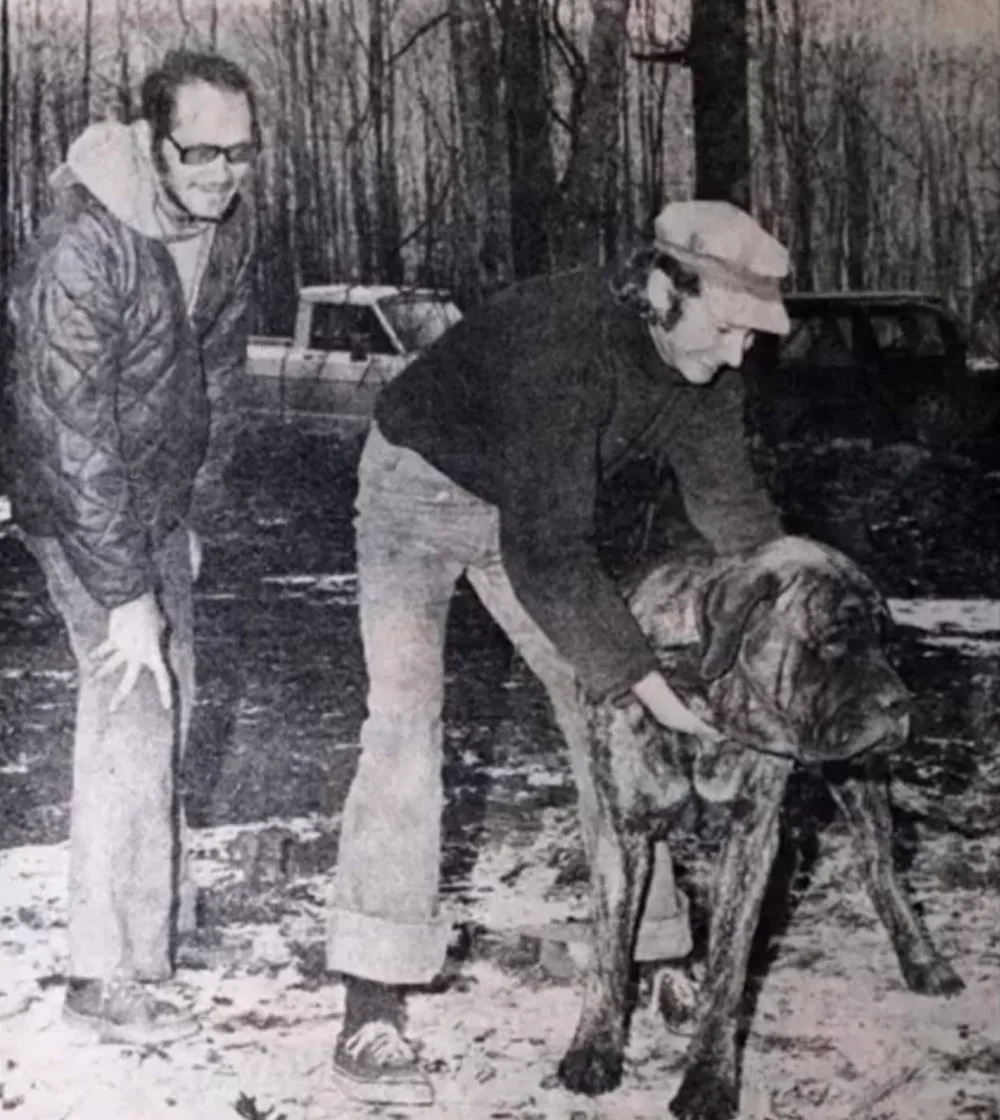
Their surviving photographs cannot tell us everything about the relationship or the private household. They can establish something more modest and more important: the victims had recognizable lives before their names became attached to a notorious building.
Building a home on Taylor’s Ridge
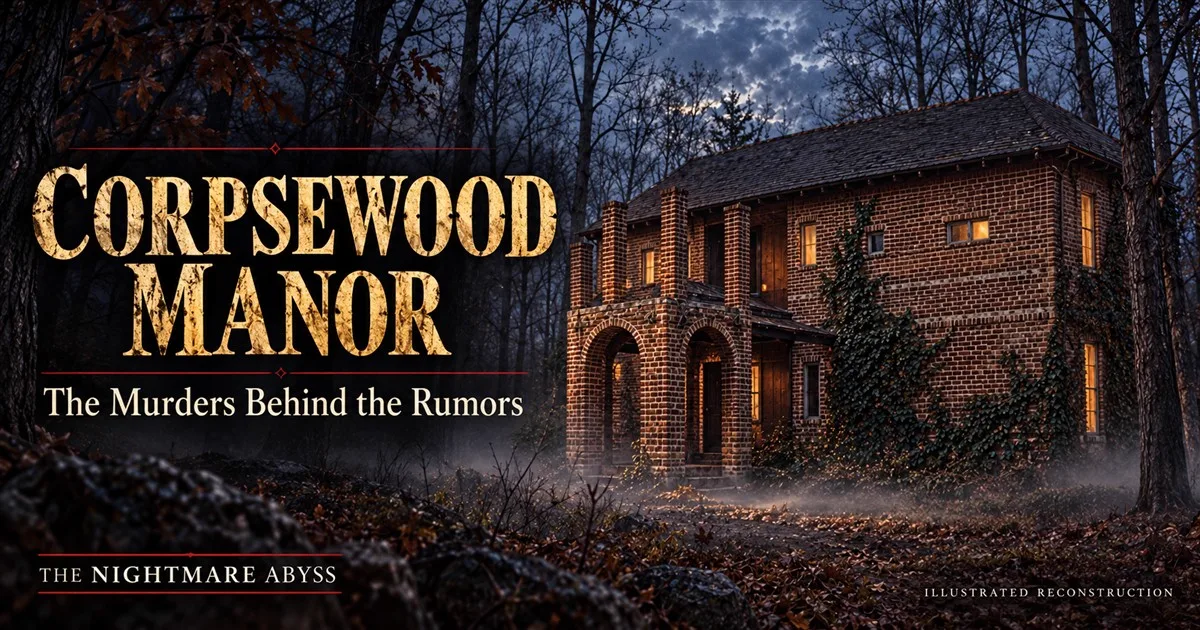
Corpsewood stood on Taylor’s Ridge in Chattooga County, near Trion. The forty-acre property supported a striking brick house whose arches and outbuildings gave it an appearance unlike an ordinary rural dwelling. It was a twentieth-century home, not an ancient castle.
Scudder’s construction account describes using approximately 45,000 bricks and installing a well pump and pipes. Photographs accompanying his article show the front gazebo or sundeck, a rear courtyard, a spiral staircase, and the pump building and outhouses. The house combined ambitious design with practical work. Scudder’s account and Pamela Purcell’s photographs.
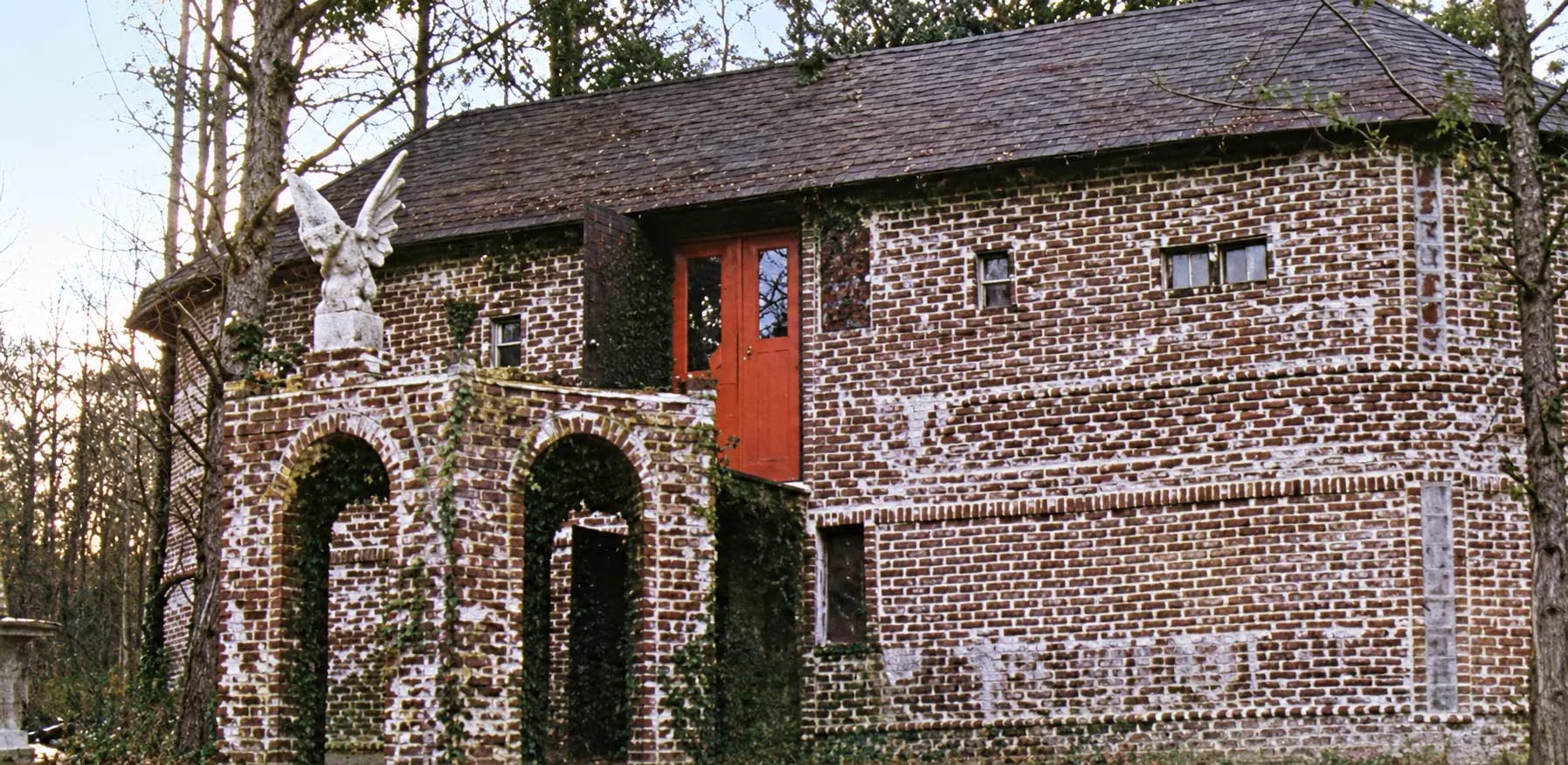
Descriptions of an isolated house can make it sound empty of ordinary activity. The pre-crime material points in the opposite direction. Buildings needed maintenance, water had to be obtained, animals needed care, and visitors could be entertained. The house was the setting of a continuing domestic project.

These images are particularly valuable because they were published before the murders. They allow us to look at the home without treating every architectural choice as a clue to what would happen there.
The visitors on December 12, 1982
The Georgia Supreme Court places the fatal visit on the evening of December 12, 1982. Samuel Tony West and Avery Brock came to the house, and Scudder welcomed them with homemade wine. The opinion says the visitors had brought an inhalant, identified as toluene, which they used while drinking. West v. State, Georgia, 1984.
A separate estate appeal preserves accounts involving Teresa Hudgins and Joey Wells. It describes a gathering in a guest building apart from the main house. That distinction matters: the people gathered with Scudder were not all in the same room as Odom when the first shots were heard. The estate opinion summarizes evidence presented in litigation; it is not a complete transcript of the criminal trial. Fiumefreddo v. Scudder.
The evidence supports a sequence of hospitality followed by coercion and theft. It does not supply a reliable record of every exchange at the table. Reconstructed dialogue, precise private thoughts, and dramatic warnings sometimes added to the story should not be confused with what the witnesses actually left on record.
What the court records say about the murders
According to the Georgia criminal appeal, Scudder was bound and gagged. Brock went to find Odom and shot him. After attempts to force Scudder to reveal where money was kept, West shot Scudder. The attackers searched the house, loaded belongings into Scudder’s Jeep, and fled. West v. State, Georgia, 1984.
The estate proceedings add another layer. Hudgins described hearing shots from the main house and Brock returning to the guest building. Scudder was still restrained when the group subsequently entered the house. But the evidence about the final pistol shots and which man survived longer was contradictory. The medical examiner could not determine the order of death. Fiumefreddo v. Scudder.
That uncertainty should remain visible. Knowing who was first attacked does not necessarily tell us who died first. Nor does the broad sequence in a criminal appeal resolve every disputed detail in the forensic evidence. The two men were murdered; a minute-by-minute account claiming certainty about their last moments goes beyond the surviving material consulted here.
Their two mastiffs were also killed, according to later reporting. This is part of the household’s destruction, not an invitation to embellish animal suffering. Atlanta Magazine’s retrospective.
The court also records competing explanations offered by West. He described revenge in statements to authorities, while at trial he alleged that Scudder had put LSD in the wine. The latter was a defense claim, not an established fact. The original laboratory report has not been examined for this article, and the accusation should not be converted into a statement that the victims drugged their guests. Georgia appeal.
The escape and the murder of Kirby Phelps
The violence did not end at Corpsewood. On December 15, West and Brock encountered Kirby Phelps at a rest area near Bovina, outside Vicksburg, Mississippi. Phelps was a twenty-six-year-old Navy lieutenant traveling from Jacksonville, Florida, toward his mother’s home in Oklahoma City. He had stopped to sleep.
The Mississippi Supreme Court’s account says Brock held Phelps at gunpoint while West handcuffed him. West then led him into the woods and shot him. The fugitives took Phelps’s Toyota. Phelps was a third victim whose death belongs in the history of the escape, even though it occurred far from the house that dominates the legend. West v. State, Mississippi, 1985.
West later gave his own account of Phelps moving toward him before the shooting. The appellate opinion attributes that account to West. It should not be narrated as an independently established explanation or justification.
The Mississippi case also illustrates why even primary records need comparison: its opening summary dates the Georgia killings differently from the Georgia opinions. This article follows the two Georgia decisions for December 12 and the Mississippi decision for the December 15 killing of Phelps.
Discovery, surrender, and the prosecutions
The forensic evidence summarized in the estate appeal says Scudder’s and Odom’s bodies were discovered four days after the murders. That places discovery on December 16, 1982. Some accounts have confused that date with the date of the crime itself. Fiumefreddo v. Scudder.
West and Brock eventually separated and surrendered. The Mississippi opinion dates West’s voluntary surrender to the evening of December 25. Later reporting sometimes gives Christmas Eve, so the precise date should be attributed rather than treated as a point on which every source agrees. Mississippi appeal.
Brock pleaded guilty and received three consecutive life sentences. A contemporary Associated Press brief published on Wednesday, February 16, 1983 reported that he had entered the plea on Tuesday, supporting February 15 as the plea date. That brief contains errors elsewhere, including the murder date, which is why its sentencing report has been checked against the broader record rather than accepted wholesale. The Daily Reflector, February 16, 1983, front page.
West’s Georgia case initially ended with convictions for two murders and armed robbery, with death sentences for the murders and life imprisonment for robbery. It did not remain in that form.
Why Tony West’s conviction was overturned
On February 15, 1984, the Georgia Supreme Court reversed West’s convictions and sentences because women were unlawfully underrepresented in the list used to select the indicting grand jury. The court ordered reindictment and retrial. It expressly found the evidence sufficient to support the convictions. West v. State, Georgia, 1984.
This was not an acquittal. It was also not simply a dispute about how many women sat on the trial jury. The problem concerned the grand-jury selection process. Those distinctions explain how a conviction could be set aside without the court declaring that the defendant had not committed the crimes.
Later reporting describes West pleading guilty and receiving life imprisonment. The later plea order has not been obtained for this article, so an exact plea date is not asserted. Atlanta Magazine.
West also faced a separate capital case in Mississippi for Phelps’s murder. In January 1985, the Mississippi Supreme Court reversed that conviction because evidence of the Georgia killings had been improperly introduced during the guilt phase. This was a different appeal in a different prosecution. It should not be merged with the Georgia grand-jury ruling. Mississippi appeal.
The estate dispute and the unanswered question
Scudder’s will left his personal property and the residue of his estate to Odom and expressly excluded his surviving children. After both men were killed, their relatives’ competing claims made the question of survivorship financially significant: had Odom lived long enough to inherit?
The resulting civil case preserved testimony and forensic details that many abbreviated crime stories omit. The appellate court found unresolved factual issues and rejected the summary disposition that had favored Scudder’s relatives. It did not make a final finding that one particular man outlived the other or award the property conclusively to a named heir. Fiumefreddo v. Scudder.
The legal dispute gives the history an uncomfortable afterlife. A home the men had shared became an estate whose distribution depended on evidence about their dying moments. It also leaves historians a useful warning: an inference permitted during an appeal is not the same thing as a settled account of an event.
Fire, abandonment, and the ruins
The house did not survive intact. A legal advertisement in The Summerville News dated December 6, 1984 offered the forty-acre estate for sale and described Corpsewood as partially destroyed by fire. This establishes that fire damage existed by that date. It does not establish the exact date of the fire, its cause, or who was responsible. December 1984 estate notice.
Modern photographs published by Oxford American in 2024 show overgrown brick remains. They document the later ruin, not the occupied house and not a site inspection conducted for this article. Luke Gregson, Oxford American.
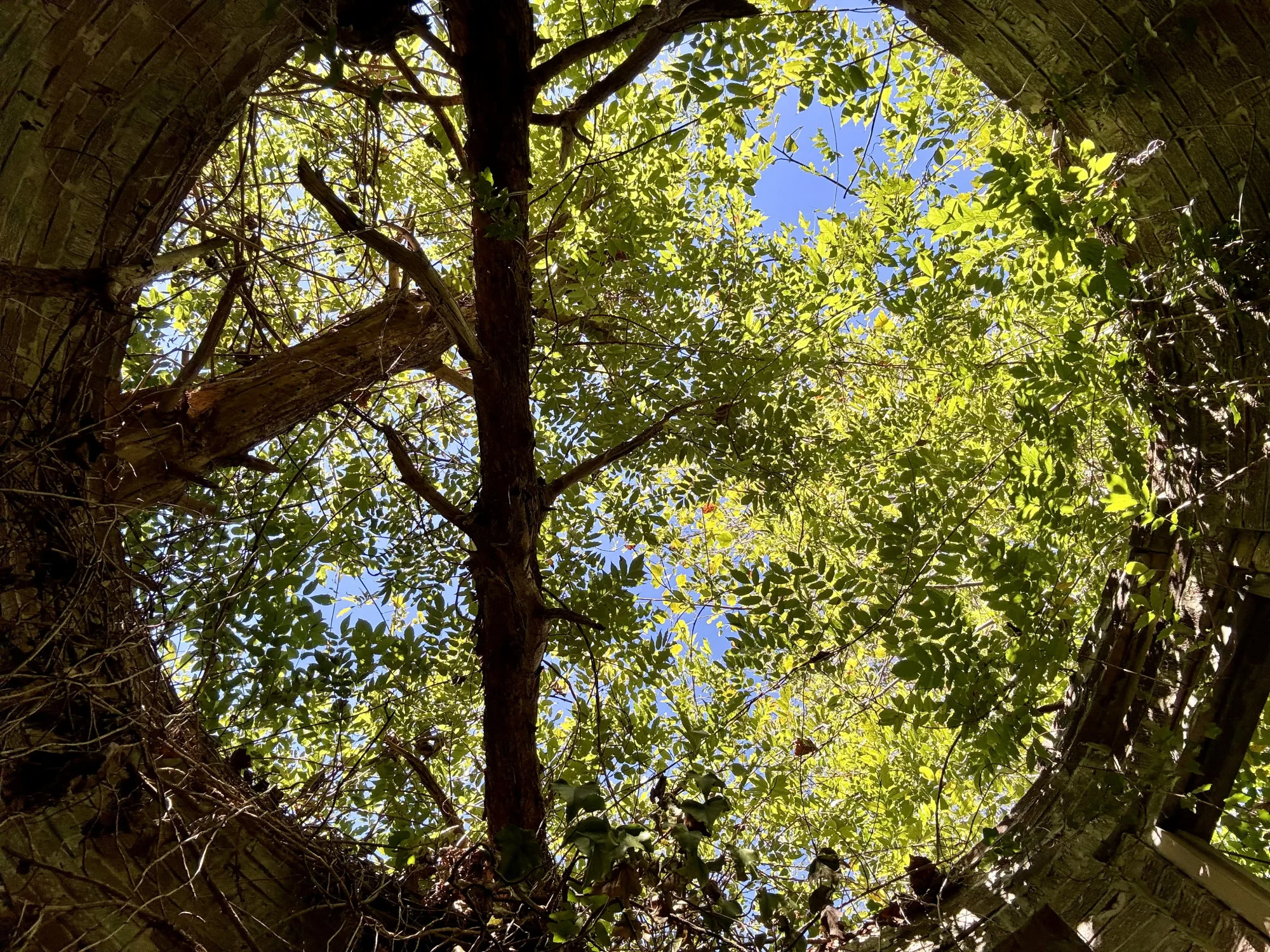
The difference between the old photographs and the later ruins is central to the story. The earlier images show decisions made by people who expected to keep living there. The later ones show what remained after those people were gone.
Published accounts describe private ownership. Nothing in this article grants permission to enter the property, and current access arrangements have not been verified. Atlanta Magazine.
Satanism, the portrait, and the haunting stories
Corpsewood’s reputation is inseparable from the way Scudder’s beliefs were discussed. The Church of Satan has stated that it located his membership material in its archives. That is direct institutional support for his affiliation, though the organization’s retrospective has a viewpoint and contains a date error. It should be used narrowly, rather than treated as an impartial account of the entire case. Odom’s membership is not established by the material reviewed here. Church of Satan’s amended account.
Religious affiliation does not establish ritual murder, supernatural activity, or a justification for violence against the men. Nor does Scudder’s academic work establish later claims about secret government experiments. Those claims require their own evidence; they cannot be inferred from an occupation and an unusual home.
Another repeated story concerns an attributed self-portrait said to predict Scudder’s death. The image’s dating and the interpretation attached to its marks have not been independently authenticated in this research. The tidy claim that a fixed number of marks foretold an identical number of wounds is especially unsafe: the forensic discussion in the estate case does not support that simple correspondence. Estate opinion; example of the later portrait story.
Accounts of supernatural dogs, unexplained sounds, and cursed bricks belong to the site’s folklore. Sources can demonstrate that people tell these stories without demonstrating that their supernatural explanations are true. Atlas Obscura’s entry.
This distinction does not remove the atmosphere from Corpsewood. It lets the reader understand where that atmosphere comes from: an unusual house, violent deaths, abandoned possessions, damaged buildings, and years of repetition. None of those things requires an invented apparition.
A chronology of the documented events
| Date | Event and evidence |
|---|---|
| 1976 | Scudder’s own account dates his resignation and change of life to this year. |
| February 22, 1979 | The Summerville News publishes a profile of Scudder and Odom at their home. |
| March 1, 1981 | Mother Earth News publishes Scudder’s construction account and photographs. |
| December 12, 1982 | Scudder and Odom are murdered, the date given by both Georgia opinions. |
| December 15, 1982 | Kirby Phelps is killed in Mississippi, according to the Mississippi opinion. |
| December 16, 1982 | Discovery of the Georgia victims, derived from the estate opinion’s four-day interval. |
| Late December 1982 | The fugitives surrender; the Mississippi court specifies December 25 for West. |
| February 15, 1983 | Brock’s guilty plea, as indicated by the next day’s Associated Press report; three consecutive life sentences follow. |
| February 15, 1984 | West’s Georgia convictions and sentences are reversed; reindictment and retrial are ordered. |
| March 14, 1984 | The Georgia Supreme Court rules in the estate dispute, leaving survivorship unresolved. |
| By December 6, 1984 | A contemporary estate advertisement records fire damage to the house. |
| January 23, 1985 | West’s separate Mississippi conviction is reversed on an evidentiary issue. |
| Later proceedings | Reporting describes West’s eventual Georgia guilty plea and life sentence; the plea order was not acquired. |
The linked sources above support this chronology. It deliberately leaves the exact fire date, the disputed order of death, and the unverified later plea date unresolved.
Remembering the people behind the legend
A ruined house makes a compelling photograph. A curse makes an easy headline. Both can push the people who lived there out of the story.
The pre-crime photographs resist that disappearance. Odom stands beside Scudder and a dog. Brick arches frame an occupied home. A staircase connects rooms that someone used. These are not clues to a supernatural fate. They are traces of a household that violence ended.
Phelps deserves the same attention. He was traveling to see his mother when the fugitives encountered him. His death should not become a passing sentence between a sensational crime and a courtroom outcome.
Corpsewood’s documented history is already dark: hospitality turned into captivity, a home was searched for valuables, and three people lost their lives across two states. Remembering them accurately is more demanding than repeating the legend. It is also the reason to return to the sources.
Sources and credibility
- Charles L. Scudder, “A Castle in the Country,” Mother Earth News, March 1, 1981. First-person, pre-crime evidence about his decisions and construction. Strong for what he described; not an independent audit. Photographs credited to Pamela Purcell.
- Pam Purcell, The Summerville News, February 22, 1979, p. 9-B. Contemporary reporting and dated identification of the men. The archive’s scan should be consulted alongside imperfect OCR.
- West v. State, 252 Ga. 156 (1984). Primary appellate opinion for the Georgia convictions, summarized trial evidence, and reversal. It is not the complete trial transcript.
- Fiumefreddo v. Scudder, 252 Ga. 279 (1984). Primary estate appeal preserving testimony and forensic disputes. Its procedural conclusions must not be recast as final findings about survivorship.
- West v. State, 463 So. 2d 1048 (Miss. 1985). Primary source for the Phelps case and its reversal. Its Georgia crime date conflicts with the Georgia opinions.
- Associated Press, The Daily Reflector, February 16, 1983, front page. Contemporary report of Brock’s plea and sentence. Its errors on other particulars are excluded here.
- The Summerville News, December 6, 1984, p. 13-A. Contemporary estate advertisement establishes fire damage by publication, not a cause or exact fire date.
- B.T. Harman, Atlanta Magazine, October 27, 2022. Reported retrospective, useful for broader context and West’s eventual life sentence. Historical custody statements are not treated as current status.
- Luke Gregson, Oxford American, October 21, 2024. Later reporting and photographs of the ruins. Not a substitute for court records where the sequence is disputed.
- Church of Satan, amended account, March 29, 2018. Institutional source used only for its membership-archive statement, with its perspective and date error acknowledged.
- Autopsy of Architecture and Atlas Obscura. Useful for tracing image reproductions and circulating folklore. Neither authenticates supernatural claims or supplies current permission to visit.
Historical and visual note: This article distinguishes contemporary records, later reporting, and folklore. The opening artwork is an AI-generated illustrated reconstruction, not an archival photograph. Historical photographs retain their individual source captions. Complete trial transcripts, original autopsy and laboratory reports, the later Georgia plea order, and a fire investigation report were not consulted. Research reviewed October 14, 2026.