Dark Legends
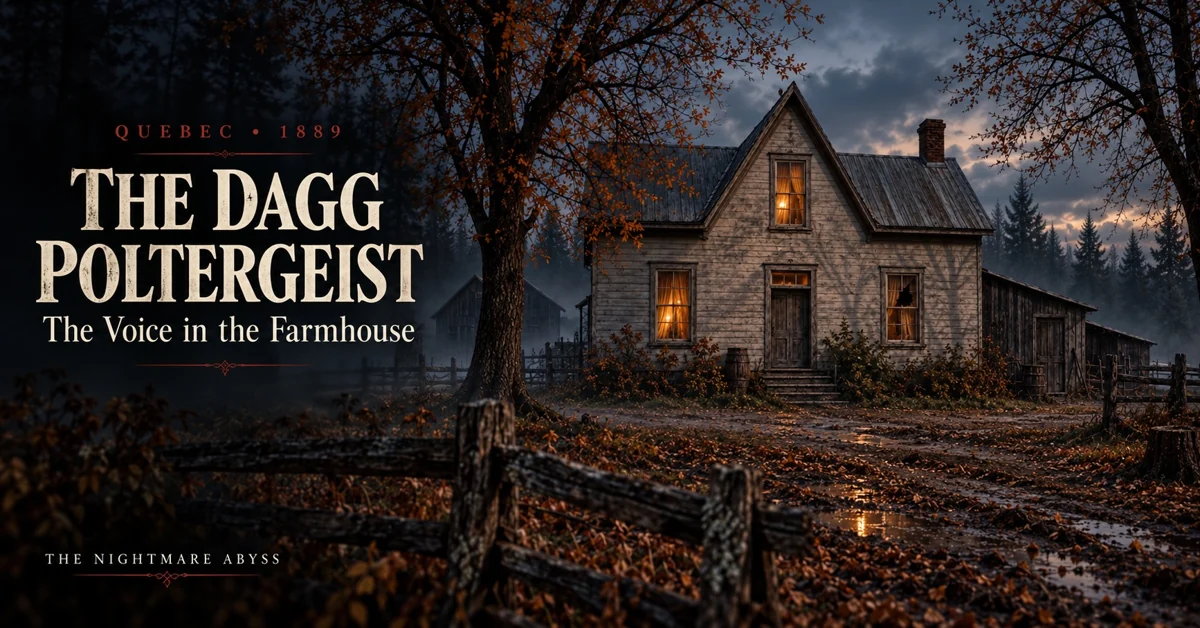
The Dagg Poltergeist: The Voice in the Farmhouse
The voice seemed close enough for Percy Woodcock to reach its owner.
Four or five feet away, according to the account. Deep, gruff, and hostile. An old man’s voice answering a child inside a shed attached to a Quebec farmhouse.
But Woodcock could see no old man.
By the time the Canadian artist arrived, the Dagg family had already reported shattered windows, fires inside the house, and household objects turning up where no one remembered leaving them. An eleven-year-old girl said she could see something the adults could not. Neighbors came to watch. Newspapers gave the disturbance a name: Dagg’s Demon.
The Dagg poltergeist story survives through newspaper accounts, printed attestations, later recollections, and retellings. Those records preserve what people claimed to experience. They do not establish that a demon, ghost, or angel occupied the house.
What they leave is an unusually intimate haunting: a family unable to trust its own rooms, a child placed at the center of public suspicion, and an unseen speaker whose reported farewell was almost as unsettling as its threats.
The Farm Near Shawville
The setting was Clarendon Township in Pontiac County, Quebec, near Shawville on the Quebec side of the Ottawa Valley. George and Susan Dagg lived there with their children. Dinah, identified in an early account as Dinah Burden McLean, also lived with the household.
The report described Dinah as eleven and as one of the children sent to Canada through British philanthropic arrangements. That brief description tells us something about her circumstances without giving us her own account of them. The story preserves what adults said about Dinah far more clearly than it preserves what she thought about the people around her.
The disturbances were traced to September 1889. One newspaper account begins with money placed in a bureau drawer: a five-dollar bill and a two-dollar bill. A boy named Dean, who did chores on the farm, returned one bill after saying he had found it near the stove. The other was reportedly discovered in his bedding.
Suspicion fell on him. He denied stealing it.
Then came other complaints. Milk and butter were disturbed. Dirt appeared on the floor. The household’s small disruptions became part of a larger story in which someone, or something, seemed determined to make ordinary life difficult.
At first, a human mischief-maker was an explanation the family could understand. The windows made that explanation harder for them to hold.
Someone Was Breaking the Windows
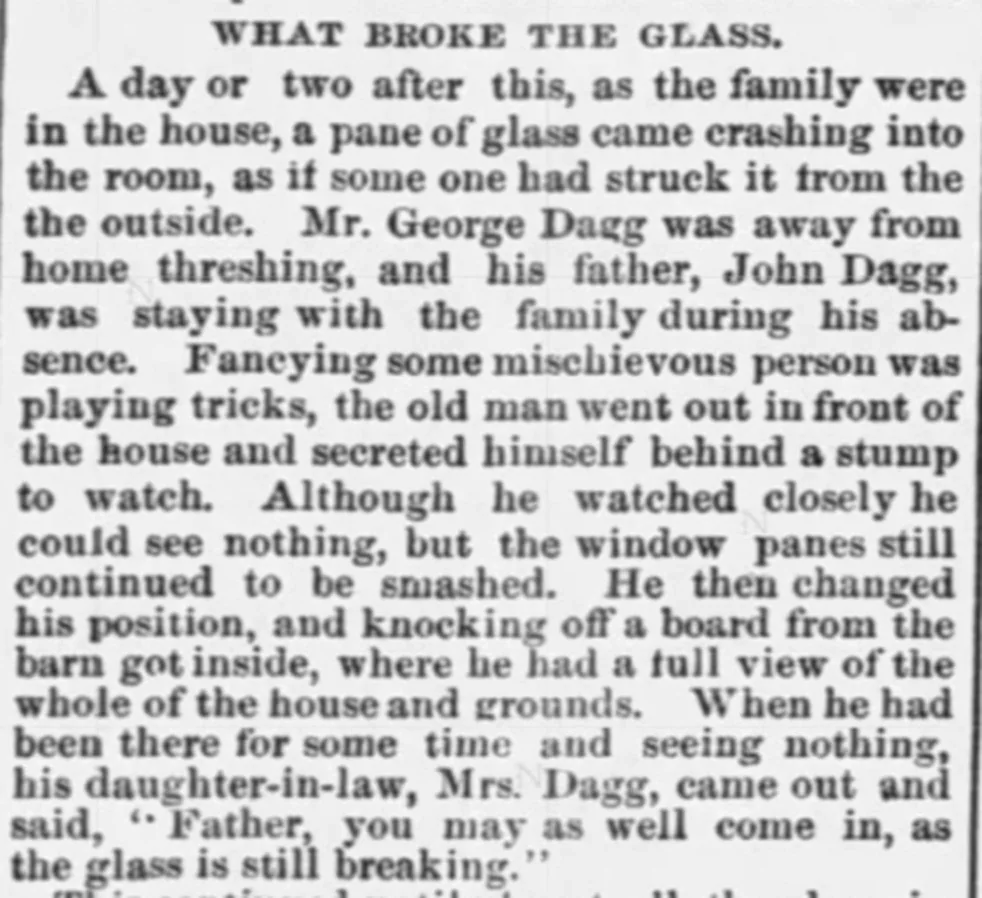
George Dagg was away threshing when his father, John, stayed with the family. According to the newspaper account, a pane of glass crashed inward as though someone had struck it from outside.
John went out to watch.
He first concealed himself behind a stump in front of the house. When the breaking continued without anyone appearing, he changed position. He removed a board from the barn and watched through the opening, giving himself a view of the house and grounds.
Still, he reported seeing no culprit.
Eventually his daughter-in-law came outside to tell him that the glass was continuing to break. His watch had not stopped it.
The scene’s force lies in its practical detail. John did not begin by describing a monster. He chose a hiding place, watched the approach to the house, and moved when the first position failed. Each step was an attempt to turn fear into something observable.
But a report that someone saw no attacker cannot tell us everything about sightlines, distractions, or where an object originated. It records John’s inability to identify the cause. For the family inside, that distinction would have offered little comfort.
When the Bed Caught Fire
Broken windows made the house vulnerable from outside. The fire reports placed the danger within.
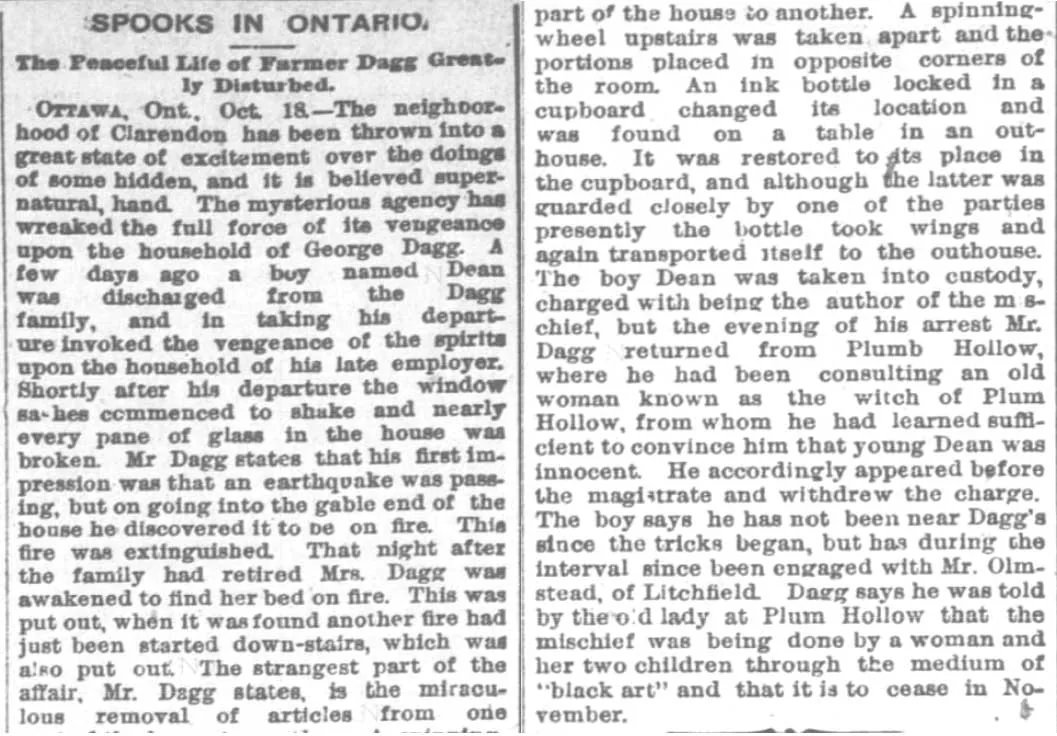
A clipping attributed by its collector to the Dunn County News of October 25, 1889, describes a fire at the gable end of the house. The family extinguished it. That night, after everyone had retired, Mrs. Dagg reportedly woke to find her bed burning.
That fire was put out too. Then another was discovered downstairs.
The account gives us a sequence of alarms and extinguished flames, but no independent fire investigation establishing how they began. It would be misleading to turn those reports into a finding of spontaneous combustion or supernatural ignition.
The same clipping describes a spinning wheel taken apart, its pieces left in different corners of a room. An ink bottle supposedly moved from a locked cupboard to an outbuilding, then repeated the journey after being returned.
These objects made the story domestic. A spinning wheel belonged to work. A bed belonged to rest. A cupboard existed to keep things where they had been put. In the Daggs’ account, each failed to behave as expected.
A family can board up a broken window. It is harder to decide where to sleep when the next alarm may begin beneath the blankets.
What Dinah Saw
One bedroom encounter puts Dinah and an older Mrs. Dagg in the same room but gives them different experiences.
The older woman was tidying when Dinah called attention to a large dark figure pulling at the bedclothes. When the woman looked, she reportedly saw the covers lifting as though someone had grasped them in the middle.
She did not see the figure Dinah described.
That separation is essential. The account does not say that everyone in the room watched a visible creature. It says that Dinah described one while the adult saw moving cloth.
The older woman handed Dinah a whipstock and urged her to strike. A neighbor named Smart entered and encouraged her as well. The child struck at what, according to the report, only she could see.
Retellings can make this scene sound triumphant, as though a household had finally found a way to fight back. Read more closely, it is disturbing for another reason. Adults were encouraging an eleven-year-old to confront a frightening presence they could not see themselves.
Whatever caused the disturbance, Dinah had become more than a witness. The adults were asking her to act on their behalf.
The Search for Someone to Blame
The family’s search for an explanation extended beyond the house.
The fire report says Dean was taken into custody on suspicion of causing the mischief. It also says George withdrew the charge after consulting a woman known as the Witch of Plum Hollow. In that account, her advice persuaded him that the boy was innocent.
This is a record of an accusation and its withdrawal, not proof that Dean stole money or caused the disturbances.
Another clipping describes suspicion shifting toward a neighboring widow, Mrs. Wallace, and her children. A witchcraft explanation had offered a new target. Mrs. Wallace denied knowing anything about it and visited the house to demonstrate that she bore the household no ill will.
Her denial belongs in the story alongside the accusation.
Haunting stories often preserve a supposed witch more readily than the person accused of being one. Here, the available account gives us no sound basis for blaming the widow. It shows how an unexplained household crisis could spread outward, drawing other people into the fear.
Percy Woodcock Hears the Voice
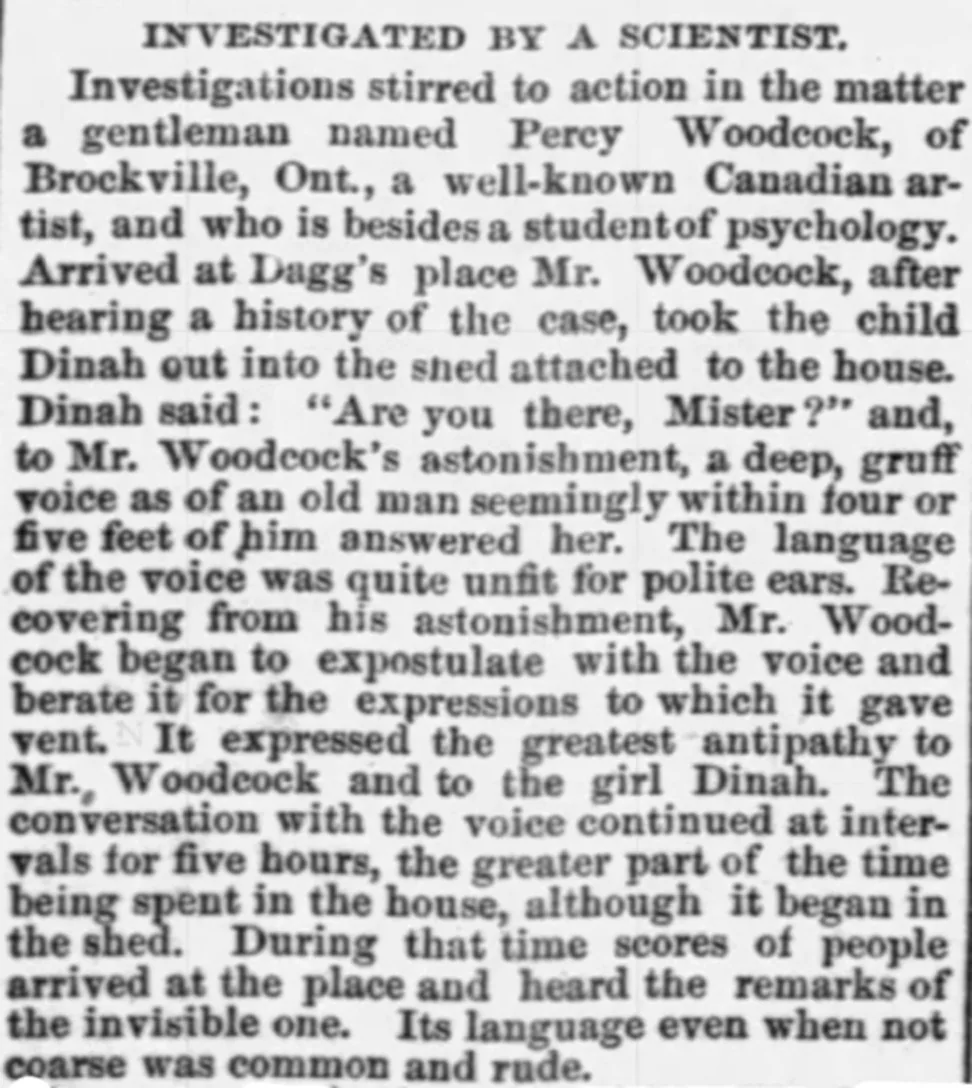
Percy Woodcock brought an outsider’s attention to the farm. He was a Canadian artist from Brockville, described in the newspaper account as a student of psychology. Although the clipping’s heading called the investigation scientific, that label should not be mistaken for evidence of a controlled experiment.
After hearing the household’s story, Woodcock went with Dinah into the attached shed. The printed account gives the first question to her.
“Are you there, Mister?”
A voice answered. Woodcock described it as deep and gruff, like an old man speaking only four or five feet away. Its language was coarse, and its manner hostile toward both him and the child.
The encounter became a conversation. Woodcock remonstrated with the speaker, which continued to respond. According to the account, the exchanges lasted intermittently for about five hours, most of that time inside the house rather than in the shed. Visitors arrived and reportedly heard the remarks too.
This was the detail that carried the Dagg story beyond the familiar sounds of a haunted house. A crash can be investigated after it happens. A voice appears to invite questions. It offers the unnerving possibility that whatever has entered the home understands the people living there.
Yet hearing a voice and identifying its source are separate matters. The surviving account tells us what Woodcock believed he heard. It does not provide an audio recording, a complete experimental record, or conditions that would let us independently rule out a concealed human speaker.
Seventeen Names and a Divided Public
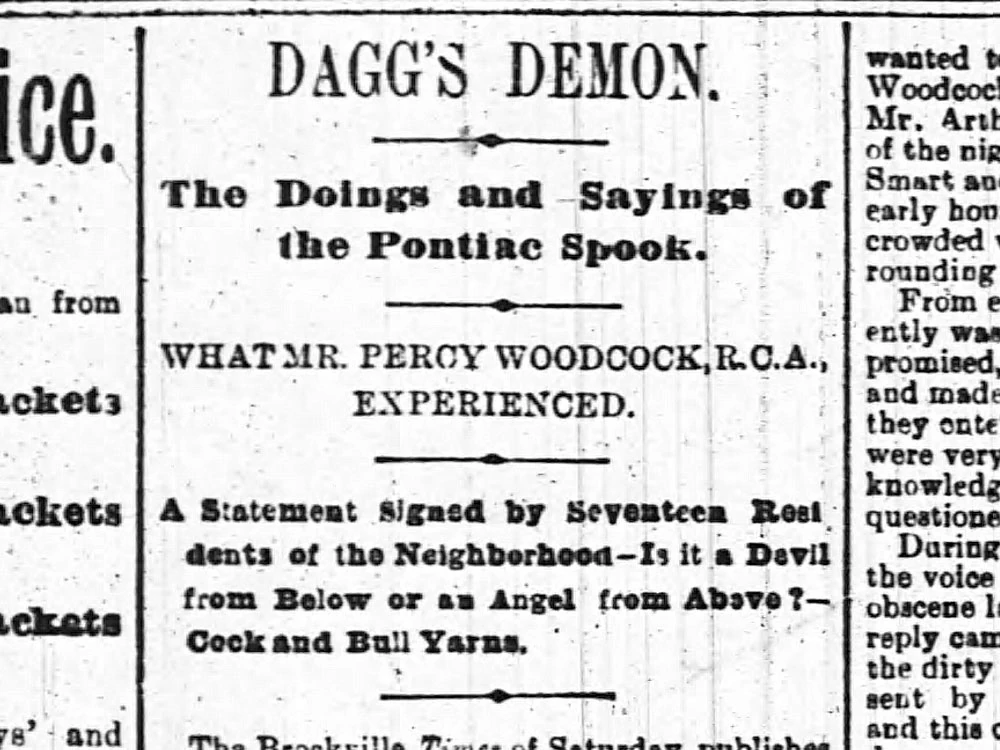
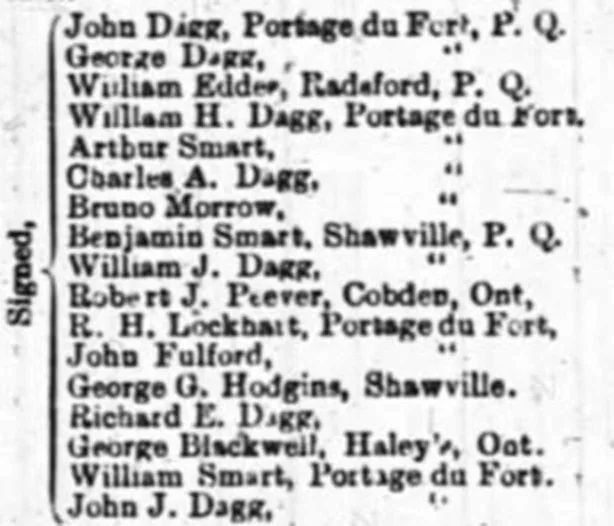
The story did not remain a private family complaint. A newspaper headline announced “Dagg’s Demon” and advertised a statement signed by seventeen residents of the neighborhood. Its subheading framed the mystery in religious terms, asking whether the presence came from below or above.
Linda Seccaspina’s newspaper index identifies the corresponding Ottawa Journal item as November 25, 1889, page 4. A separately preserved clipping prints the names associated with an attestation.
Those names matter. They show that the story circulated beyond one household and that people were publicly associated with its claims. They do not establish that every person witnessed every incident, or that a supernatural explanation was independently tested seventeen times.
Skepticism was part of the contemporary coverage too. Seccaspina’s index preserves Ottawa Journal headings from November 29, 1889, including “Dagg’s Dupes” and “Dinah a Ventriloquist.” The public argument was already underway within days of the better-known headline.
A further fragment in the research collection asserted that Dinah produced the voice and said orphan-home authorities had taken her away. Its publication details are incomplete, and its certainty is an editorial judgment rather than a demonstrated explanation of every reported event.
It would be as careless to erase this skepticism as it would be to treat the accusation against Dinah as a proven confession. The surviving material preserves belief and doubt, often in forceful language, with a child between them.
The Stranger at the Well
The reported ending changes the story’s appearance completely.
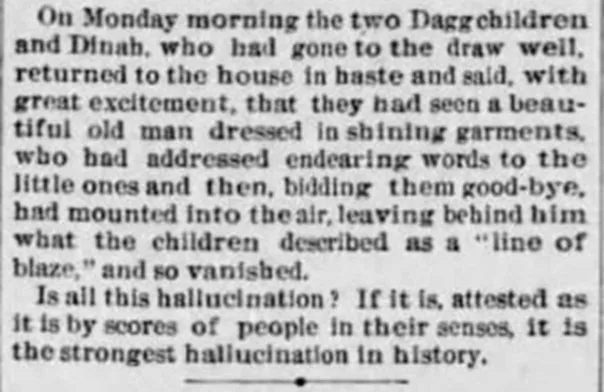
In a surviving newspaper fragment, the Dagg children and Dinah return from the draw well on a Monday morning. They say they have seen a beautiful old man dressed in shining garments. He speaks kindly to them, says goodbye, and rises into the air.
Behind him, they describe a “line of blaze.”
The contrast is extraordinary: the house’s hostile voice gives way, in the farewell tradition, to a radiant stranger offering affectionate words to children. Whether these were understood as the same presence, or how the account acquired this ending, cannot be settled from the fragment alone.
The scene is the children’s reported experience. The clipping does not establish that adults watched the ascent, and it lacks the publication information needed to fix the event confidently to a calendar date.
Its uncertainty does not diminish its place in the legend. A frightening stranger can be recognized as a threat. A gentle one, arriving after weeks of fear, asks for something more difficult: trust.
What the Record Can Tell Us
The evidence is strongest when establishing that the Dagg haunting was a publicly reported controversy in 1889. Newspapers named the household, described disturbances, reported Woodcock’s involvement, and printed both supportive and skeptical material.
The evidence is more limited when we ask exactly what happened inside each room. Many surviving images are fragments rather than complete pages. Some dates come from collectors’ captions. The sequence of individual incidents is not secure enough to reconstruct a precise daily timeline.
The supernatural explanation is a further step beyond those reports. Broken glass, fire, apparent movement, and a disembodied voice would each require their own investigation. A single explanation may feel satisfying without accounting for all of them.
Deliberate tricks, misperception, rumor, and embellishment are possible explanations for parts of the story. The surviving material does not let us assign every incident to a specific person or mechanism. Nor does an unanswered question establish a paranormal cause.
Dinah’s later life is also unresolved in the material examined here. Conflicting departure stories should not be combined into an account of abduction or disappearance. Silence in a fragmented archive is not evidence of a final supernatural event.
As with the Greenbrier Ghost, the historical question includes what people did because of an extraordinary claim. At the Dagg farm, people watched, questioned, accused, defended, and published. Those human responses are part of the story even when the cause of the disturbance remains uncertain.
Why the Dagg Poltergeist Endures
In 1957, the National Film Board of Canada returned to the case in The Ghost that Talked, directed by Don Haldane. Its official catalog identifies the production as a dramatization based on Woodcock’s firsthand report. The film demonstrates the story’s continuing cultural life; it is not new evidence for the haunting.
The title identifies what makes the case linger. The farmhouse did not merely produce noises. In the account that survived, it answered.
Perhaps someone understood how to make a voice seem ownerless. Perhaps an accumulating story taught frightened listeners what to expect. Perhaps the missing records would change how we understand the entire affair. We cannot recover those answers by making the darkness more elaborate.
We can return to the scene the newspaper describes: Woodcock beside Dinah, a shed attached to an ordinary home, and a question directed toward someone neither of them could show to the reader.
The reply sounded only a few feet away.
More than a century later, the distance between that voice and its source remains the most unsettling space in the Dagg farmhouse.
Sources and Credibility
- Arlene Stafford-Wilson: Ottawa Valley Poltergeist clipping collection. The locally supplied newspaper images form the main basis for the household narrative. They were read alongside the existing research dossier and checked visually where reproduced here. These are valuable records of published claims, but several crops lack mastheads, dates, or complete article context. Collector-supplied dates are identified as such.
- Linda Seccaspina: The Dagg Poltergeist of Shawville Original Newspaper Story 1889. Useful for identifying the Ottawa Journal coverage of November 25 and 29, 1889, and locating skeptical coverage alongside the famous headline. It is a modern clipping index; the full original newspaper issues were not examined for this article.
- Kenton de Jong: The Mystery of Dagg’s Demon. Credited as the reproduction source for the headline image already in the research package. The image’s filename contains a year error. It is not used as an independent witness or as authority for the detailed chronology.
- National Film Board of Canada: The Ghost that Talked. Institutional source for the 1957 film’s date, director, and relationship to Woodcock’s report. It supports the adaptation history, not the reality of the supernatural claims.
Historical and image note: This article distinguishes reported experiences, contemporary accusations, and later interpretation. The archival clippings retain their original pixels. The cover is AI-generated artwork. No authenticated photograph of an apparition, reconstructed character likeness, or proven paranormal cause is claimed.